IndiaWatchesTV: The click economy has a ceiling, television breaks through it
Established brands across the board say television leads in building awareness, familiarity and trust even as digital plays a role in driving conversions
 by
Published: Nov 5, 2026 8:44 AM | 5 min read
 Follow Us


- Television remains a significant medium for advertisers, providing a familiar and comforting environment for audiences, despite the rise of digital platforms and multi-screen consumption habits.
- Long-running television shows, such as "Yeh Rishta Kya Kehlata Hai" and "KBC," maintain a loyal viewer base, making them attractive for brands seeking consistent consumer engagement and brand recognition.
- Advertisers, particularly in the FMCG sector, continue to value television for its ability to build brand familiarity and trust, even as they invest in digital marketing for targeted engagement.
- The advertising landscape is evolving, with projections indicating growth in connected TV advertising, highlighting the complementary roles of television and digital media in achieving different marketing objectives.
Remember when missing an episode of your favourite television serial meant missing an entire evening's conversation? When families arranged dinner around prime time, advertisements became familiar household jingles, and television characters were discussed almost as frequently as relatives?
Television may not always command consumers’ attention throughout the day, but it continues to hold a place in their living spaces and daily routines. As consumers move seamlessly between television, smartphones, laptops and other screens at different points of the day, their media consumption remains spread across platforms. For advertisers, this presents an opportunity to connect with audiences across screens while television continues to offer the familiarity and comfort of a shared household experience.
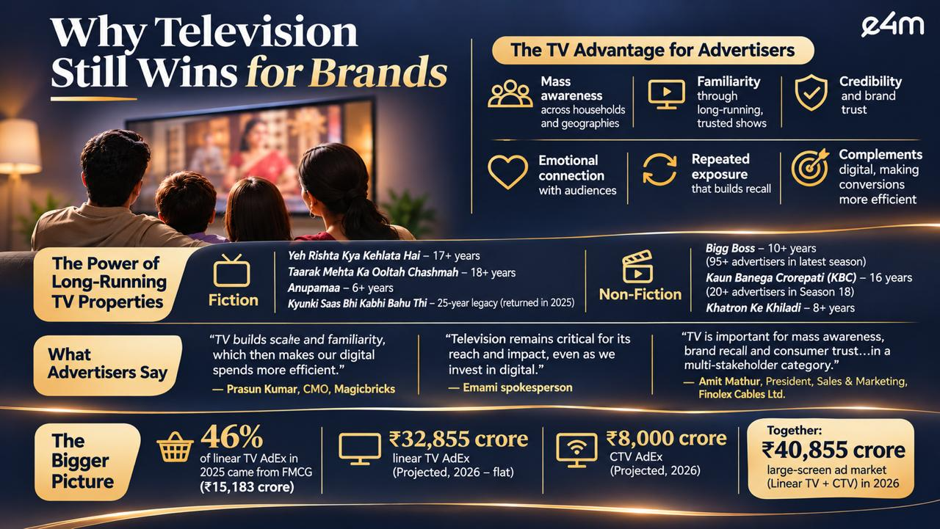
What makes the proposition particularly interesting is the longevity of television's established properties. Yeh Rishta Kya Kehlata Hai has been running for more than 17 years, Taarak Mehta Ka Ooltah Chashmah for over 18 years, and Anupama for more than six. Kyunki Saas Bhi Kabhi Bahu Thi, meanwhile, returned in 2025, reviving a franchise with a 25-year legacy.
On the other hand, long-running non-fiction shows such as Bigg Boss, Kaun Banega Crorepati (KBC) and Khatron Ke Khiladi continue to generate renewed interest among advertisers. With Bigg Boss running for over a decade, KBC for 16 years and Khatron Ke Khiladi for more than eight years, these shows have built a loyal audience base and sustained familiarity, making them attractive platforms for brands seeking consistent consumer engagement.
Talking about the latest seasons, Bigg Boss bagged 100+ advertisers while KBC Season 18 locked in 20+ advertisers. This continued interest of brands on these long-running shows highlights the importance of the medium in the marketers’ media mix.
For advertisers, these programmes offer more than individual ratings. They create familiar environments where brands can build recognition through repeated exposure.
According to the Pitch Madison Advertising Report 2026, FMCG continued to account for approximately 46% of linear television advertising expenditure in 2025, contributing Rs 15,183 crore.
The figure reinforces television's continuing importance in categories where brands need visibility across households, geographies and consumer segments.
For such advertisers, awareness cannot always be reduced to an immediate click or transaction. Brand familiarity often needs to be established long before a consumer reaches the point of purchase.
The advantage that cannot always be clicked
Prasun Kumar, Chief Marketing Officer of Magicbricks, believes television's contribution is often underestimated because its impact is harder to attribute to immediate consumer actions.
“Television remains a core pillar of our strategy, and I’d argue it is often undervalued in boardroom conversations precisely because it is harder to attribute than a click,” Kumar told exchange4media.
Digital-first marketing, he believes, has made brands more disciplined about evaluating television without necessarily reducing its relevance.
Television can build awareness and familiarity at scale, while digital platforms help advertisers reach consumers at specific moments in their purchase journeys.
“We see TV as the engine that builds scale and familiarity, which then makes our digital spends more efficient, because people are searching for, clicking on and converting for brands they already recognise,” Kumar said.
The argument is particularly relevant for high-involvement categories such as real estate, where consumers may encounter a brand several times before actively searching for a property.
Kumar also identifies television's ability to create emotional connections, establish credibility and generate repeated exposure through habitual viewing as important advantages.
Digital, meanwhile, offers sharper targeting, real-time optimisation and measurable lower-funnel outcomes.
The two, therefore, need not compete for identical roles in the marketing funnel.
Television Remains Critical for Brands to Build Trust and Perception
For FMCG advertisers, the importance of television extends beyond individual programmes.
An Emami spokesperson told exchange4media, “Television remains critical for advertisers like Emami. Television continues to be relevant for its reach and impact, even as we invest in digital, reflecting the evolving media consumption landscape.”
Emami's assessment reflects the balance that many traditional mass-market advertisers must navigate: maintaining widespread brand recognition while investing in platforms that offer more precise consumer targeting.
The relevance of television becomes particularly interesting in categories where purchase decisions involve multiple stakeholders.
Amit Mathur, President, Sales and Marketing, Finolex Cables Ltd., said television remains important for mass awareness, brand recall and consumer trust.
“While digital has changed how we plan and measure campaigns, it has not reduced television’s relevance. At Finolex Cables, we see the two as complementary, with television providing scale and digital helping us drive targeted engagement and extend the campaign’s reach,” Mathur said.
In electrical cables, consumers are not necessarily the only decision-makers. Electricians, dealers and retailers can also influence brand selection.
“In a category like ours, where purchase decisions involve electricians, dealers and end consumers, consistent visibility helps build familiarity and trust,” Mathur explained.
For brands with extensive physical distribution networks, that recognition can be especially valuable. Consumers may encounter advertisements on television but make their final purchase at a neighbourhood retail outlet.
The effectiveness of such exposure cannot always be evaluated through online conversion data alone.
The bigger screen is evolving
Pitch Madison's 2026 projections also point to an evolution in large-screen advertising.
While linear TV advertising expenditure is forecast to remain steady at Rs 32,855 crore in 2026, connected TV advertising is projected to grow from approximately Rs 6,000 crore in 2025 to Rs 8,000 crore.
Together, linear television and CTV represent a projected Rs 40,855 crore large-screen advertising market in 2026.
The argument is no longer that television must replace digital or retain every rupee of its historical advertising share.
It is that brands continue to require different media for different objectives.
Television builds recognition, credibility and mental availability. Digital can deepen engagement, personalise communication and capture demand.
Neither medium automatically guarantees effectiveness, and both must justify investment against measurable business objectives.
But as television continues to bring audiences back to familiar programmes, its ability to build brands before consumers actively begin searching for them remains an important advertising advantage.
In a marketing world increasingly focused on converting demand, television continues to make a compelling case for its role in creating it.
Read more news about Television Media, Digital Media, Advertising India, Marketing News, PR and Corporate Communication News
For more updates, be socially connected with us onInstagram, LinkedIn, Twitter, Facebook YouTube & Google News
